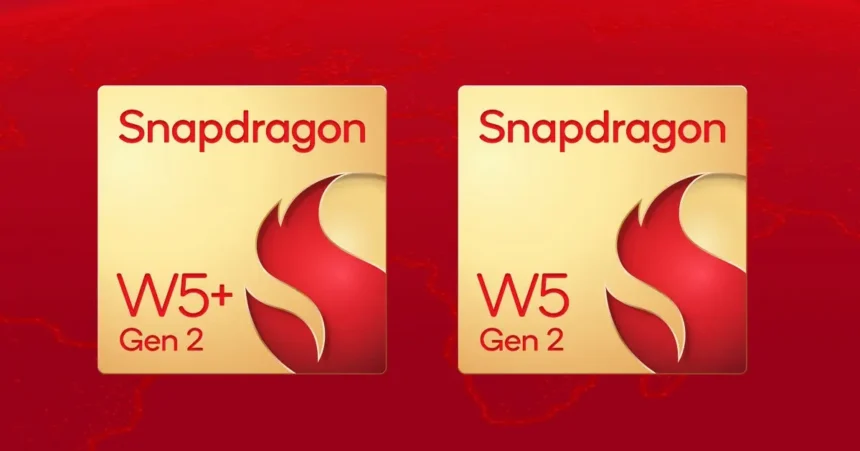
Qualcomm’s new smartwatch chips are here, and the focus is refreshingly simple: make watches more reliable in the real world. The Snapdragon W5 Gen 2 and W5+ Gen 2 keep performance steady while improving how your watch finds your location, saves battery, and reaches help when there’s no cell signal. The standard W5 Gen 2 is already shipping in the Google Pixel Watch 4, which tells you this isn’t a lab demo—it’s real and on wrists now.
Let’s start with the basics. Qualcomm stuck with a 4nm process and the familiar quad‑core setup using four Cortex‑A53 cores. That means day‑to‑day speed feels similar to the last generation. And that’s fine. Watches don’t need laptop power. What they do need is dependable connectivity, smart battery behavior, and accurate positioning. That’s where the new platform steps up.
The standout upgrade is satellite messaging. The platform supports NB‑NTN (Narrowband Non‑Terrestrial Network), which lets a watch talk to satellites when cell towers are out of reach. Picture a hike where your phone shows zero bars or a long stretch of highway with spotty coverage. You can still send messages to get help—straight from the watch, no phone required. That kind of safety net matters far more than another tiny bump in CPU clocks.
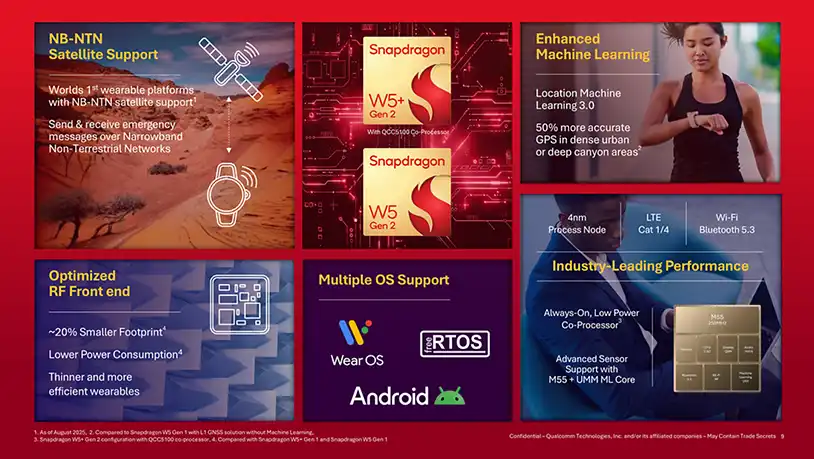
Location accuracy also gets a real-world boost. With Qualcomm’s Location Machine Learning 3.0, GPS data is cleaner in places where signals usually get messy—downtown streets with tall buildings, narrow alleys, or spots where reflections throw off your route. In practice, your map won’t jump around as much, and turn-by-turn walking directions feel more trustworthy. It’s one of those upgrades you notice the first time you compare an old route to a new one.
There’s thoughtful hardware tuning, too. The RF front end—the radio bits that handle wireless—has been trimmed down and made more efficient. It’s about 20% smaller and uses less power. That helps watchmakers build slimmer designs and squeeze more hours between charges. On a wrist device, even small savings show up as an extra chunk of battery life at the end of the day.
So, what’s the difference between W5 Gen 2 and W5+ Gen 2? The plus version adds a dedicated low‑power co‑processor built on a 22nm node. Think of it as a helper chip that quietly runs background tasks—sensors, notifications, audio cues—while the main processor naps. The idea is simple: keep the essentials going without waking the big cores, which saves energy. If a brand wants longer endurance without making the watch thicker, this is how they get there.
Both chips are built on 4nm, use four Cortex‑A53 cores up to 1.7GHz, and pair with an Adreno 702 GPU. Connectivity covers Bluetooth 5.3, Wi‑Fi, and global satellite systems like GPS, GLONASS, Galileo, and BeiDou. Add NB‑NTN satellite messaging to the list for the emergency angle. The platform is tuned for Wear OS and also supports Android and FreeRTOS, so brands have some flexibility on software while keeping things smooth for Google’s watch ecosystem.
What didn’t change? Raw horsepower. Qualcomm chose to prioritize reliability, safety, and efficiency over chasing benchmark numbers. That’s the right call for a smartwatch. People want a watch that lasts, tracks accurately, and can reach help when things go wrong. If apps open a fraction faster, great—but most would trade that for dependable battery life and better connectivity every time.
Availability is already underway. Pixel Watch 4 runs the W5 Gen 2, and more Wear OS models should follow. If choosing between the two chips from a buyer’s point of view, here’s the quick read: W5 Gen 2 is already in consumer devices and leans slim; W5+ Gen 2 is for watches that want longer battery life by offloading background jobs to that co‑processor. Either way, you get tighter GPS, smaller and thriftier radios, and satellite SOS for those no-signal moments.
Quick buyer tips:
- No phone needed for satellite messaging support on devices that enable NB‑NTN.
- Expect the biggest benefits in city navigation and outdoor safety.
- Battery gains will vary by watchmaker, software tuning, and how aggressively they use the co‑processor.
Also Read | Dimensity 9500 vs 8 Elite Gen 2 – Which Flagship Chip Wins 2025